Rubber Material Selection Under Global Energy Shifts
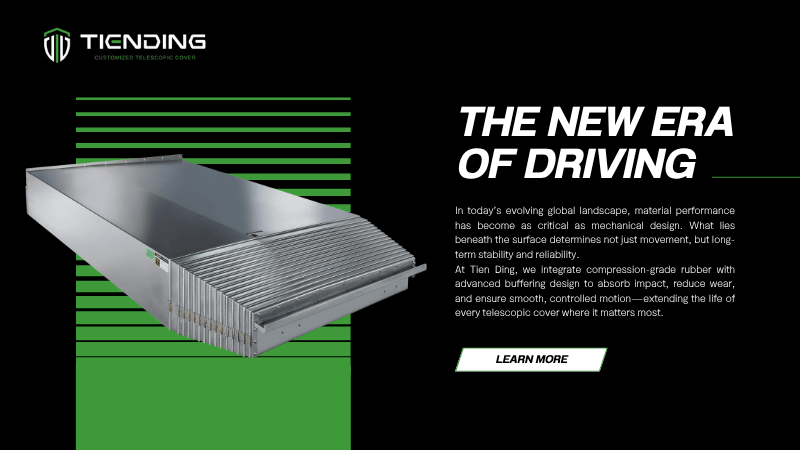
— How Buffer Design Impacts the Service Life of Telescopic Covers
In recent years, global manufacturing supply chains have been significantly influenced by energy dynamics and geopolitical factors. Rubber materials, as typical petrochemical derivatives, are highly dependent on crude oil markets in terms of both pricing and supply stability. This dependency directly affects critical components used in machine tools, including telescopic covers, where rubber elements play an essential role in buffering and motion control.
Studies show that both natural rubber and synthetic rubber prices are closely correlated with crude oil prices in both the short and long term. This relationship is particularly pronounced for synthetic rubber, whose raw materials—such as butadiene and styrene—are directly derived from petroleum cracking processes. As a result, fluctuations in oil prices have a direct impact on material costs, especially for components integrated into telescopic cover systems.
Against the backdrop of rising energy prices and increasing supply chain uncertainty, rubber components are no longer considered low-priority items. Instead, they have become critical factors affecting product performance, cost structure, and long-term reliability—particularly in high-cycle applications such as telescopic covers in machine tools, where durability and motion stability are essential.
The Engineering Role of Buffer Systems in Telescopic Covers
In high-speed machine tool environments, telescopic covers are not static protective structures. They operate as dynamic systems subjected to continuous motion and cyclic loading.
During reciprocating movement, cover segments accumulate and release kinetic energy. The contact interfaces between segments must therefore incorporate effective energy absorption mechanisms.
Buffer rubber components serve not merely as anti-collision elements, but as integral parts of the system responsible for:
-
Impact absorption
-
Contact damping
-
Motion stabilization
When buffer performance degrades, the system transitions from controlled, damped contact to rigid mechanical collision, resulting in:
-
Direct metal-to-metal contact between cover segments
-
Localized stress concentration
-
Amplified structural vibration
-
Accelerated wear
These effects are typically observed as abnormal noise and reduced service life.
Primary Failure Mechanisms of Rubber Components
In practical applications, buffer rubber elements are mainly subject to three major failure mechanisms:
1. Compression Set
When rubber remains under prolonged compression, its molecular structure gradually loses elasticity. This reduces its ability to return to its original shape, directly diminishing its capacity to absorb impact energy.
2. Wear and Fatigue
Under repeated contact and micro-sliding conditions, the rubber surface develops cracks and material loss. Over time, this leads to progressive structural degradation and performance decline.
3. Chemical Degradation
Cutting fluids often contain oils and additives that can cause rubber swelling, hardening, or molecular chain breakdown. Material compatibility varies significantly depending on composition. For example, NBR (Nitrile Butadiene Rubber) is widely used in industrial environments due to its superior oil resistance.
The Influence of Manufacturing Processes on Material Performance
The manufacturing process of rubber components plays a critical role in determining their structural integrity and durability. The two most common processes are injection molding and compression molding.
Injection-Grade Rubber
Injection molding requires materials with high flowability to fill molds efficiently. These materials typically have a looser molecular structure, which supports production efficiency and dimensional consistency. However, under long-term compressive loading, their resistance to compression set is relatively weaker.
Compression-Grade Rubber
Compression molding involves curing rubber under high temperature and pressure directly within the mold, resulting in a denser molecular network structure. This provides:
-
Higher resistance to compression deformation
-
Improved fatigue resistance
-
More stable mechanical properties
This is why high-reliability sealing components, such as O-rings, are typically produced using compression molding.
System-Level Thinking in Buffer Design
In real-world applications, material selection alone is not sufficient. The configuration and placement of buffer components significantly influence overall system behavior.
Effective buffer system design must consider:
-
Contact location and load distribution
-
Dynamic contact sequence throughout the stroke
-
Multi-point buffering and energy distribution
-
Coordination with telescopic cover structure and motion
Through proper engineering design, instantaneous impact forces can be transformed into gradual energy dissipation, reducing localized stress and extending component life.
The Relationship Between Material Selection and Product Lifespan
In an environment where raw material costs fluctuate, manufacturers often face trade-offs in material selection. However, in applications involving high-cycle loading and oil exposure, these differences become significantly amplified over time.
For telescopic covers:
-
Lower-grade materials may meet short-term functional requirements
-
But they tend to degrade more quickly
In contrast, materials with higher crosslink density and better fatigue resistance can maintain stable performance under the same operating conditions, reducing maintenance frequency and minimizing downtime risk.
Conclusion
In mechanical systems, small components often perform critical functions.
For telescopic covers, buffer rubber elements are not merely anti-impact parts — they are essential to motion quality, system stability, and overall service life. Under conditions of fluctuating global supply chains and raw material costs, material selection is no longer just a cost consideration. It is a fundamental engineering decision that directly affects structural reliability, maintenance frequency, and long-term operational risk.
These differences may not be immediately visible during initial operation, but over time, they become decisive factors in determining system durability and performance consistency.
If you are currently designing or optimizing a telescopic cover system — especially for high-cycle, high-load, or oil-exposed environments — selecting the right buffer material and structural configuration is critical.
At Tien Ding Industrial Co., Ltd., we work closely with machine builders and industrial users to evaluate real operating conditions, identify potential failure risks, and recommend optimized solutions for long-term reliability.
Contact our engineering team to discuss your application requirements and explore a more durable, performance-driven telescopic cover solution tailored to your system.
Frequently Asked Questions (FAQ)
Q1. Why are buffer rubber components so critical in telescopic cover systems?
A: Buffer rubber components absorb impact energy and stabilize motion between cover segments. Without proper buffering, repeated metal-to-metal contact leads to vibration, noise, and accelerated wear.
Q2. How do I know if my buffer rubber is failing?
A: Signs include abnormal noise, increased vibration, visible deformation, hardening, or reduced damping performance. In severe cases, direct segment contact may occur.
Q3. Which material is better for oil-exposed environments?
A: NBR is generally preferred due to its superior oil and chemical resistance, making it more stable in cutting fluid environments.
Q4. Does manufacturing process affect rubber performance?
A: Yes. Compression-molded rubber typically offers better long-term durability and resistance to deformation compared to injection-molded rubber.
Q5. Can lower-cost materials impact machine reliability?
A: Yes. While they may work short-term, lower-grade materials degrade faster under demanding conditions, increasing maintenance needs and downtime risk.
Catagory
Recent News
Key Engineering Considerations in Large Vertical Turning Lathe (VTL) Design
Why Telescopic Covers Must Be Involved Earlier in Turn-Mill Machine Design?